
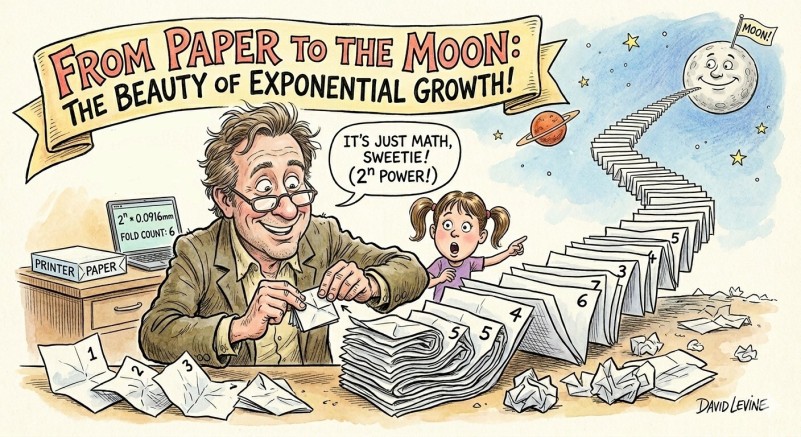
The Beauty of Exponential Growth: From Paper to the Moon
The bridge between arithmetic and the cosmos is built on knowledge. Knowledge is a web of data-often from vastly different fields—that complements and converges to help us understand a specific topic, whether narrow or broad. It is a spectrum of disciplines that flows into various subjects, each building upon and reinforcing the others.
With this in mind, I turned to my daughter and asked: "How many times do you think you could fold a single sheet of paper in half?" Her guess was far higher than reality allows, which prompted me to prove the surprising truth to her.
We took a sheet of paper from the printer and began folding. One, two, three... we managed six folds, and no more. The sheer thickness accumulated so quickly that further folding became impossible.
Then, I posed a follow-up: "If we could keep folding without limit, how many times would we need to fold that paper for its thickness to reach the Moon?" Again, her guess was far off. To find the answer, we turned to formulas.
The Calculation
First, we needed our data. The distance from Earth to the Moon is approximately 384,400 km. Next, we needed the thickness of a single sheet. We took a ream of paper, measured the total height, and divided it by the number of sheets. The result: a single A4 sheet is 0.0916 mm thick.
With each fold, the thickness doubles:
- 1 fold: 2 layers
- 2 folds: 4 layers
- 3 folds: 8 layers
- 4 folds: 16 layers... and so on ($2^n$).
Mathematically, the formula is:
$Thickness = 0.0916 \text{ mm} \times 2^n$
Adding a Little "Space Spice"
We decided to up the stakes and check the distance to Mars. Unlike the Moon or the Sun, which stay at a relatively consistent distance, Mars orbits the Sun at a different pace than Earth. This means the distance between us is constantly changing. For our experiment, we used the record for the closest Mars has ever been to Earth.
To make the math even clearer, we also ran the numbers using a 1 mm piece of cardboard as our starting point.
From Math to Code
Finally, I added one more layer to the project: programming. I wrote a script to handle these massive calculations instantly. We started the code together, and I finished the fine-tuning. For the tech-savvy among you, the code is available to download and modify as you wish.
Can you guess how many folds it takes? Test your theories using the interactive table below: