

Fools are certain they know. The wise know that they do not.
Most readers of these lines will raise an eyebrow in dismissal at the suggestion that they belong to the “wrong” camp.
Whether it’s politics, vaccines, religion, or veganism-right and left, sacred and secular, to vaccinate or not, animal-based or plant-based, and any other firmly held belief.
Each camp is convinced it is right, and presents persuasive arguments-arguments that reinforce its claims and align with its worldview. I am not claiming that truth or justice lies with one side or the other. No. I am claiming that we do not know. We do not know what forces shape our consciousness, and history is not always clearly laid out before us in an objective way. Naturally, we tend to choose the side that fits our culture, our society, the environment in which we were raised, our personality, and the content we are exposed to. We bring examples from our own experiences-or stories we’ve heard-as evidence to support our claims. And so, we become devout believers in a particular idea, a particular side, a particular camp.
There are only a few cases in which we can trace the origins of the forces that culturally “program” us. Let us look at one such case: gender, and the way it is separated through colors. We are conditioned to infer gender based on color. This is a subjective truth that is embedded in us as if it were objective. We are programmed into this dichotomy that distinguishes between genders using color-with no real justification.
For most of us, this “truth” feels completely objective-even if we oppose this color-based separation, even if we refuse to take part in social conventions, even if we do not want it to apply to us. A baby dressed in pink pants and a pink shirt will instinctively be associated with feminine traits, and we will immediately assume it is a girl. Even if we personally reject this social color dichotomy, we will assume that the baby’s parents accept it-that for them, color represents gender-and we will automatically conclude that the baby is female.
In other words, we have accepted that others use color to distinguish gender. Which means that even those who reject the distinction are still socially aware of it-and therefore, it applies to them as well.
But it wasn’t always this way. History shows that for centuries, babies were dressed in white-boys and girls alike. All wore gowns, hats, and clothing designed to make diaper changes easier-and all in white.
In the mid-19th century, toward the end of the Victorian era, color slowly began to enter the picture. At first, these were pastel shades in baby clothing, but they still carried no gender meaning. There was no connection between pink and blue-or between color and gender at all.
In fact, the association between color and gender began in a way that is the opposite of what we think today. A debate in the United States over which colors should be assigned to each gender led to two opposing camps-one of which became dominant.
In 1914, the American newspaper Sunday Sentinel advised mothers:
“If you are in favor of colorful baby clothes, use pink for boys and blue for girls-if you follow social conventions.”
Indeed-the exact opposite of what feels obvious to us today.
In 1918, an article in Ladies’ Home Journal stated that:
“The debate has been settled: the accepted convention is pink for boys and blue for girls. The reason is that pink is a stronger, more decisive color, associated with strength and vitality, making it suitable for boys, while blue is more delicate, refined, and elegant-thus more appropriate for girls.”
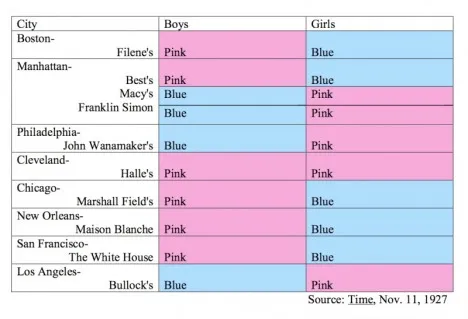
In 1927, thirteen years later, Time Magazine published a chart of “appropriate” colors for boys and girls based on leading U.S. retailers. Filene’s in Boston instructed parents to dress boys in pink-along with Best & Co in New York, Halle’s in Cleveland, and Marshall Field in Chicago. Pink-for boys.
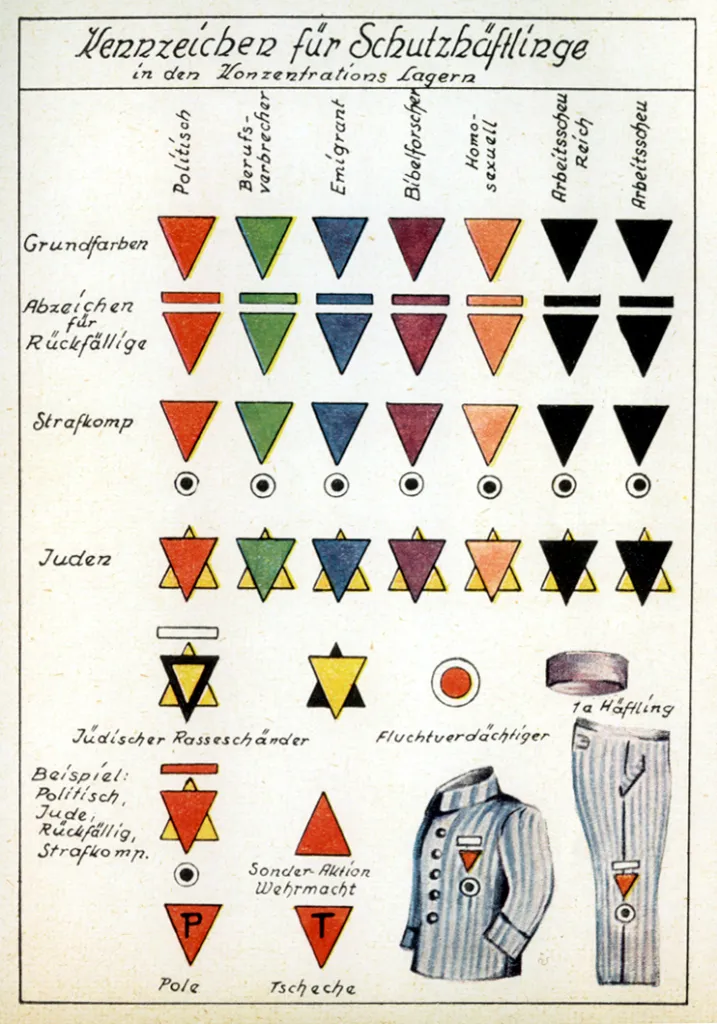
The turning point came in the 1940s, during World War II. The Nazis began systematically categorizing and marking prisoners. Part of this system involved color-coded symbols. Just as Jews were forced to wear a yellow Star of David as a mark of humiliation, homosexual prisoners were marked with an inverted pink triangle. In this context, the triangle carried a connotation associated with femininity and was intended to degrade these men. Between the 1930s and 1944, an estimated 50,000 to 63,000 homosexual prisoners were held in German camps.
In the 1950s, the post-war years, America moved away from colors associated with military uniforms-khaki, dark green, and gray-and embraced brighter, more cheerful colors. This shift influenced not only fashion but consumer goods in general. Products were manufactured in brighter colors, kitchen cabinets appeared in pink, and baby clothing followed suit.
With the rise of the women’s liberation movement in the 1960s, unisex baby clothing returned. Throughout the late 1960s and into the 1970s, baby fashion was colorful-but largely gender-neutral.
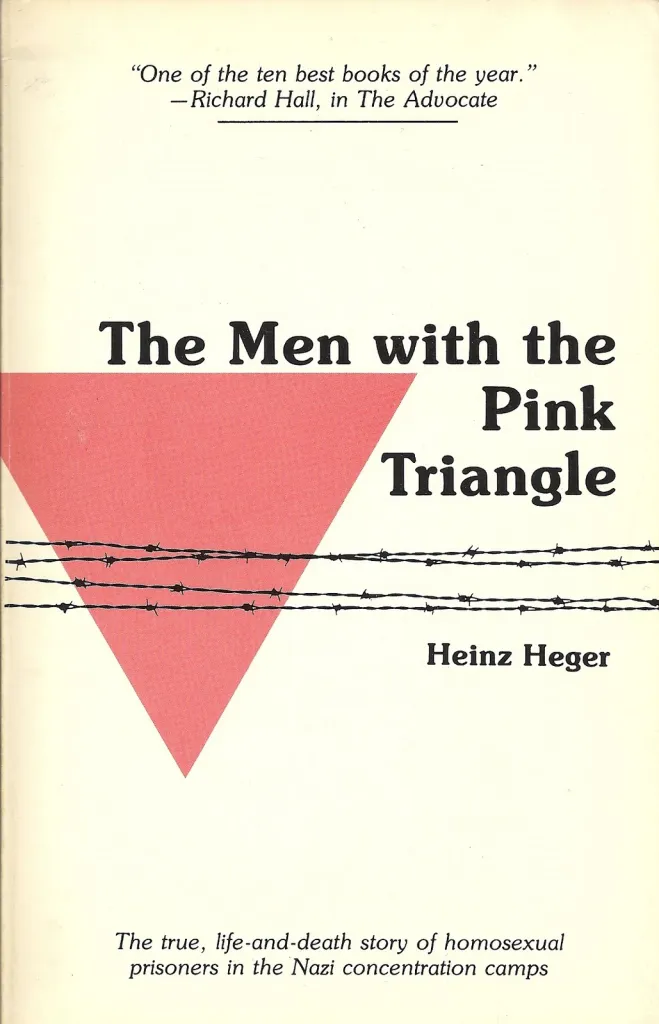
At the same time, in the early 1970s, Heinz Heger, a homosexual Holocaust survivor, published a book titled The Men with the Pink Triangle. His work had a major impact, contributing significantly to the development of the LGBTQ+ rights movement. The pink triangle was transformed-from a symbol of humiliation-into an international symbol of gay pride.
This shift further strengthened the association between pink and femininity. Then, with the widespread use of prenatal sex testing in the 1980s, pink and blue returned to baby fashion-this time with renewed significance. Parents who could now know the baby’s sex in advance began preparing accordingly, “designing” the baby’s environment ahead of time. One of the most prominent choices was color: pink for girls, blue for boys.
Manufacturers of clothing, toys, and baby products recognized the influence of color on parents and began reinforcing this gender division. Until then, clothes were often passed down regardless of color-an older brother’s clothes would go to a younger sister, and vice versa. Color simply wasn’t an issue. But companies found a way to leverage gender for profit. Through large-scale marketing campaigns and aggressive strategies, they created a clear color-based dichotomy. Now, parents expecting a girl after having a boy would often buy entirely new sets of products in “appropriate” colors-effectively doubling company revenues. The hypothetical American father who did not want his son associated with anything perceived as “feminine” would make sure to mark him with the “right” color.
Today, we are culturally programmed. This division feels entirely objective-and we pay for it accordingly. Add a mix of capital interests and a touch of Nazi madness, and you get an effective formula for producing a seemingly timeless “objective” gender distinction-one whose origins most of us neither know nor question. Pink is feminine. Blue is masculine.
This kind of mistaken gender division is not limited to colors. Skirts originated as European garments; dresses have Middle Eastern roots; high heels were once an integral part of Persian warriors’ attire. Shooting arrows from horseback became more accurate thanks to heels, which helped anchor the rider’s feet in the stirrups. Heels were common in early 17th-century Persia and spread across Europe. Men adopted them as a status symbol representing power and strength. Over time, lower classes adopted them as well, prompting the elite to increase heel height to distinguish themselves. Women, seeking status and power, began imitating men-cutting their hair, smoking pipes, wearing hats, and adopting high heels. But as they were perceived as superficial, they were left with the heels, which became a fashion item. Men, in turn, abandoned them to differentiate themselves, and by 1740 had stopped wearing heels altogether. What was once a male symbol became a female consumer product-and for nearly 300 years, heels have defined the wearer’s gender, rather than the other way around.
It may seem impossible to break such deeply rooted conditioning. But awareness alone can begin to dissolve even the most entrenched cultural assumptions. Every widespread social axiom likely has a reason-but those reasons are rarely accessible to us. And so, more often than not, we are left to choose a side-and accept the many conventions that come with it.