
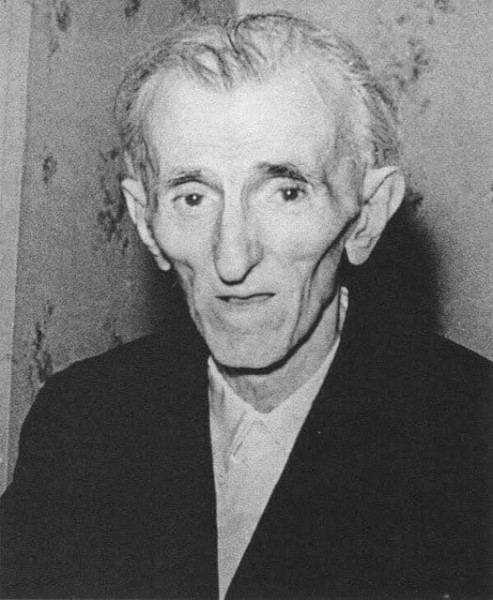
This is the last known photograph of the legendary, mysterious, and truly unique scientist—after whom Elon Musk’s electric car company, a rock band, and of course the unit of electricity are named: Tesla.
Taken on January 1, 1943.
The life and death of Nikola Tesla were, without a doubt, unusual. Tesla was responsible for many inventions that were nearly a hundred years ahead of their time—almost as if someone today were to invent a time machine. Such an invention would seem impossible, requiring knowledge we simply do not yet possess.
So—people thought he was insane. A fantasist. A charlatan who claimed to invent things just to attract funding from investors. Today, however, we have advanced tools that allow us to understand—and be amazed by—the fact that all of his calculations and discoveries (at least those that were preserved) were correct.
Tesla invented, predicted, or contributed to the development of hundreds of technologies that are now an inseparable part of our daily lives: remote control, neon and fluorescent lighting, wireless transmission, computers, smartphones, laser beams, X-ray imaging, electromagnetism, robotics, and of course—electric current (alternating current), which forms the foundation of our modern electrical systems.
In fact, he developed the technology that makes mobile phones possible—long before they were even imagined.
In 1917, the U.S. government destroyed Tesla’s laboratory. The exact reasons are unknown, but one theory suggests it was out of fear that German spies might use his technologies to intercept communications during World War I. Another theory claims the government feared his inventions—and his capabilities.
To this day, some of his discoveries have not been fully understood or successfully recreated.
During World War II, in 1943, America’s most prolific inventor, Nikola Tesla, was murdered in a hotel room in New York.
Eighty crates containing his secret research were confiscated. Sixty of them were later returned—but twenty disappeared without a trace. No one knows what became of them.
The murder was never solved. However, fragments of information collected over the years may offer some logic behind one of the mysteries surrounding him. There is reason to believe that his residence in a small hotel room was not accidental. Beneath the hotel, a system of tunnels was discovered—apparently used by him. On one of the upper floors, a room believed to have served as his laboratory was found. And in the basement, a massive generator was discovered—producing three times more electricity than the hotel required. Whether he chose the location himself, or it was selected—or even built—for him by unknown entities, it seems likely that he used the site to conduct secret experiments.
Some scientists have attempted to trace his research through declassified CIA and FBI documents (which may have played a role in the disappearance of his materials), and even to reconstruct parts of it—such as wireless electricity, lighting bulbs in midair or underground, powering entire cities without cables using the atmosphere, time travel, laser beams capable of downing hundreds of aircraft in a single shot, receiving signals from outer space, and more.
His IQ (estimated using various criteria) is believed to have been between 160 and 310.
A documentary TV series titled “The Tesla Files” might interest you. (If you’d like a link to watch all episodes, feel free to leave a comment.)
And a fun fact to finish:
In the 2006 film The Prestige (starring Hugh Jackman, Christian Bale, and Michael Caine), the filmmakers made special efforts to cast David Bowie as Tesla. In the film, Tesla is portrayed as a mysterious scientist whose genius inventions no one can fully understand. Bowie had previously decided to stop acting, but ultimately agreed—after being told that no one else in the world could truly capture Tesla’s enigmatic character.