
I was recently asked: what is the right way to raise children in this new world? A world where the traditional "Holy Trinity" of prestigious professions-Doctor, Lawyer, and Pilot-has expanded into a square, with the fourth corner occupied by the "Entrepreneur."
Let’s assume for a moment that one out of every two parents is a lawyer by profession. This means almost every child has the chance to "play" at these three traditional roles from infancy. They encounter pilots and doctors in books and media, and they mimic the lawyers they see at home.
But what is the added value of the aura surrounding a "profession" that offers no guarantee of a steady paycheck, status, or fame? By definition, an entrepreneur is someone striving toward a distant goal; until they reach it, can they even be considered a "professional"?
So, why has entrepreneurship rapidly become the new coveted destination in the spectrum of careers we dream of for our children? Some would say it’s the vision or the dream. Others see it as a path to self-actualization that is more attainable today than ever before. Some simply call it the freedom to create.
Born to Create
Unlike the three canonical professions I mentioned-which often represent the parents' aspirations-an entrepreneur is born, not made. In fact, we are all born entrepreneurs. It isn’t acquired knowledge; it is an innate, natural, and innocent trait.
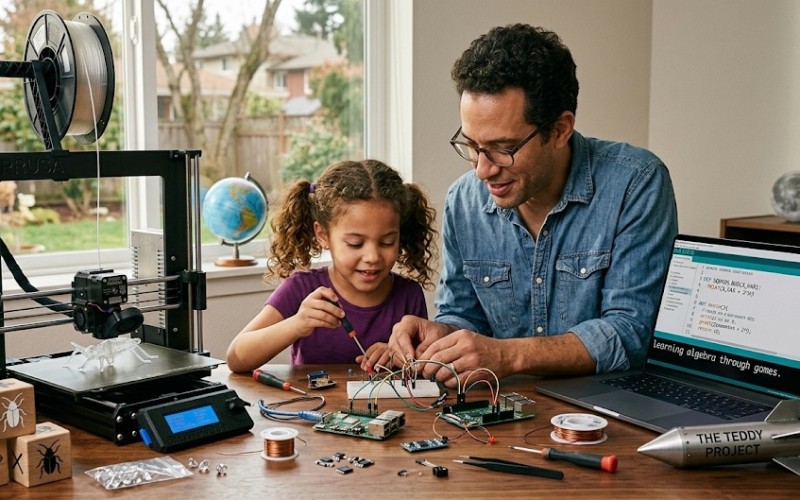
Children are constant inventors. They build structures, tinker with gadgets, create solutions, and think outside the box. They are uniquely enthusiastic about pieces of information that we adults take for granted. Rules don’t confine them; they are curious, creative, and they soak up information at an incredible speed. They fail often, but they apply what they learn with genuine excitement.
This is the exact toolkit every entrepreneur wishes they had. Combine these traits with the inherent teenage desire to conquer and change the world, and you have the "sweet dream" of a bright, successful future.
Protecting the Instinct
In almost every other profession, you must acquire specific skills to practice. Here, the primary task is simply to prevent the suppression of the natural creative instinct. We must support it. Fuel it. Develop the skills that are hard-wired into us by default.
Had we lived during the Industrial Revolution, we likely couldn't have given our children the tools to manage textile factories or become the engineers who built the machines. Today, the situation is different. The tools are available to us and our children alike-accessible, user-friendly, and perfectly suited to the modern era. In the past, machines ruled. Today, software is king.
The "Evil" Device as a Gateway
Like most parents I know, I initially refused to install games on my phone for my young children. I hoped to decrease the chance they would take an interest in the "evil toy" that would surely ruin their lives, make them addicts, and taint their pure souls.
However, I quickly realized the potential hidden within it. I saw the ability to channel the very "disadvantages" I feared into clear, valuable advantages. Today, my phone is full of games. Seeing my children mimic me by holding the device brings me a sense of confidence and joy.
Every app and game on that phone serves a purpose: education, training, or problem-solving. Almost all of them are perfectly disguised as play. I’ve become a researcher of sorts-filtering games based on the skills they develop, the quality of information they convey, and most importantly, their "stealth" factor. I look for the perfect camouflage: a sophisticated cognitive development system hidden inside a game.
Learning Without a Blackboard
I find that computer games that simply teach a child how to manage a spreadsheet, for example, have little value-that can be taught with a chalkboard. I look for games that offer an added value unique to a digital environment. I also avoid games based purely on luck. Luck is a part of life, but there are so many other skills to master first; I’m happy to let "luck" show up randomly in their future on its own. While games like Takki or Tetris have clear value, they aren't the focus here.
Few people are intimately familiar with terms like "functions," "recursion," "loops," and "commands." My children don't know the names of these concepts either, but they certainly use them. These are the building blocks of programming-the tools used to develop the software, apps, and sites that every high-tech entrepreneur dreams of owning. Through these games, children learn the "behavior" of code. All that remains for them later is to connect the formal terms to the knowledge they’ve already internalized.
Cockroaches and Algebra
My daughter knows algebra. When she was three, I gave her a game where she had to "squash" disgusting bugs. She loved the game itself; I loved the fact that a white cockroach represented a "plus," a black one was a "minus," and diamonds represented "X." The equation became tangible.
Games = The right way to create a need that leads to voluntary learning. By the time she was three and a half, she understood algebra fluently without ever knowing she was doing math. When the time comes, all she will have to do is swap the bugs and diamonds for numbers and variables. It will be "child’s play" for her.
I have found games that teach arithmetic, coding, algebra, reading, and writing in multiple languages, as well as interactive apps that turn physical experiences-like a museum visit-into an adventure. I regularly update my collection of these apps in our homeschooling Facebook group. if you are interested, you are more than welcome to tell me and I will send a bunch.
The Virtual Machine
If we return to the comparison between the Industrial and Technological revolutions: if we wanted to build a machine back then, we needed gears, chains, and metal plates. It was nearly impossible for the average person. Today, even a young child can use accessible technology to watch their "virtual machine" take shape-whether as an app, a website, or a physical product using Arduino.
The possibilities are laid out at our children's feet, more so today than ever before. These tools are becoming a second language for them-just one more set of instruments on the path to a future rich with opportunity.
To conclude, here are a few recommended books from the last decade that provide a solid foundation for these ideas. They are in English and are suitable for both parents and children:
- The Lean Startup (The modern approach to building a venture): https://amzn.to/2tJwaEV
- Starting Your Own Business (For Kids): https://amzn.to/2tF0SQc
- Entrepreneurship – Definitely Not for Men Only: https://amzn.to/2tCTZ1K
Good luck with your venture!